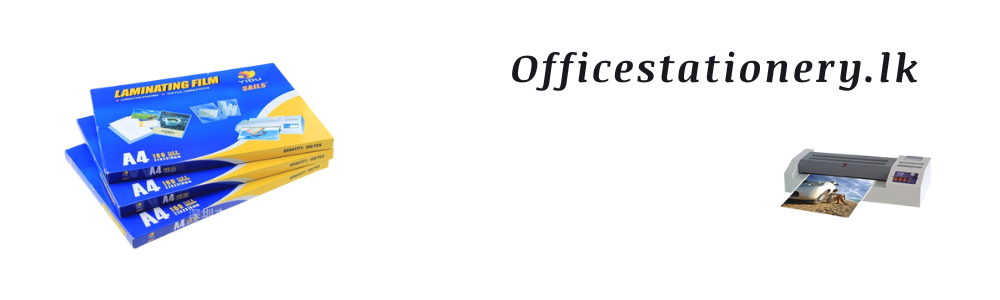
What is a laminating pouch and how do you choose one?
A laminating pouch is a pre-sealed sleeve of two clear plastic films, joined along one edge, that bonds permanently around a document when passed through a heated laminating machine. To choose the right one you match two things to your job: the sheet size (A4, A3 or ID/card size) and the thickness in microns — 80–100 micron for everyday documents, 125–150 micron for menus and frequently handled sheets, and up to 250 micron for rigid signage and display work. At Officestationery.lk we stock a range of sizes and thicknesses to cover all three needs.
Understanding micron thickness
Pouch thickness is measured in microns, where one micron equals one-thousandth of a millimetre. The higher the micron count, the thicker and more rigid the finished laminate. One detail that confuses many buyers: the micron rating usually describes a single sheet, not the whole pouch. As Meter Australia explains, “each 80 micron Laminating Pouch has two sheets of 80 micron film joined on the short edge,” so an 80-micron pouch produces a finished thickness of about 160 micron once sealed.
Fellowes, one of the largest laminating-equipment manufacturers, sums up the trade-off simply:
“the higher the number of microns, the thicker and more rigid the laminating pouch.”
Fellowes, Choose the Right Laminating Pouch
Which micron thickness for which job?
- 75–80 micron: the most popular choice — ideal for light, everyday use such as documents, indoor notices and certificates that are handled occasionally.
- 100–125 micron: better for items handled often, like restaurant menus, price lists and construction plans.
- 150 micron: a step up in stiffness for intensive handling and harsher environments.
- 250 micron: heavy-duty — gives a rigid finish that resists curling and bending, suited to signage and display boards.
Manufacturers vary in how they quote thickness — some state the per-side micron value, others the total — so check the spec against your machine’s rated capacity before buying. (Source: The Laminator Warehouse.)
Common pouch sizes
- A4 (210 × 297 mm): the standard for letters, reports, certificates and notices — the most common size sold.
- A3 (297 × 420 mm): for posters, charts, plans and large signage.
- ID / card size: for ID cards, business cards and badges.
- Legal / FS size: for longer foolscap and legal documents.
Always pick a pouch a little larger than your document so a sealed clear margin runs all the way around the edge — that margin is what keeps moisture out.
How to laminate, step by step
- Let the machine warm up to its ready light, then check it is set for the micron range you are using.
- Place the document inside the pouch, centred, with the sealed edge feeding in first and an even border on all sides.
- Feed the sealed edge into the rollers and let the machine pull the pouch through — never force it.
- Lay the warm laminate flat to cool; cooling is what sets the bond and prevents curl.
- Trim any excess, leaving a small sealed margin so the edges stay closed.
Why lamination is worth it
Lamination is a small global industry in its own right, which is one reason the materials are widely available and affordable. The global lamination films market was valued at USD 6.84 billion in 2024 and is forecast to reach USD 11.63 billion by 2032, growing at a 7.0% CAGR, according to DataM Intelligence. For an individual document, the benefits are practical:
- Protection: a sealed pouch shields paper from spills, tears, fingerprints and fading.
- Professional finish: a clean, glossy surface that looks the part for menus, signage and presentations.
- Reusability: a laminated checklist, label or sign can be wiped clean and used again and again.
Choosing a laminating machine
Your pouch and machine have to match: an A3 document needs an A3-capable laminator, and thicker pouches need a machine rated for that micron range. Alongside pouches, Officestationery.lk stocks several A3-capable machines:
Storage and care tips
Keep unused pouches flat in a cool, dry place out of direct sunlight, which is sensible in Sri Lanka’s humidity — bending or curling pouches before use can cause uneven seals and trapped air. Run a cleaning sheet through your machine periodically to keep the rollers free of adhesive build-up.
-
What micron thickness should I choose for everyday documents?
For everyday documents, notices and certificates, 75 to 100 micron pouches are the most popular choice. Step up to 125 to 150 micron for items handled often, like menus, and 250 micron for rigid signage.
-
Does the micron number mean each sheet or the whole pouch?
The micron rating usually describes a single sheet of film. An 80 micron pouch has two 80 micron sheets, so the finished laminate is about 160 micron thick once sealed.
-
Are laminating pouches compatible with all machines?
Most pouches work with standard pouch laminators, but you must match both size and micron range. An A3 pouch needs an A3 machine, and thicker pouches need a machine rated for that thickness, so check your machine’s specification first.
-
What pouch sizes does Officestationery.lk offer?
Officestationery.lk stocks a range of laminating pouch sizes, including A4 and A3, in various thicknesses and pack quantities to suit different documents and budgets.
-
How do I contact Officestationery.lk?
You can reach Officestationery.lk at No 51/1, St. Michael’s Road, Colombo 03, by email at [email protected], or by phone on 071 888 1111. Opening hours are Monday to Friday 9 A.M to 5.30 P.M and Saturday 9 A.M to 1 P.M.
 Fast dispatch via Prompt XPress
 Fast dispatch via PickMe
 Fast dispatch via Koombiyo Delivery
 Pay with KOKO — Buy now, pay later
 Monthly installments on orders over Rs. 10,000
 Island-wide delivery